A more independent life
Human augmentation + Wearable devices + Artificial intelligence + 3D printing
 DISTRIBUTED
A GLOBAL NETWORK OF THINK TANKS
People, knowledge and technology working together. From a question worth asking to a project worth building — in any country, for a real human need.
01 / WHAT WE EXPLORE
Seventeen fields. Countless connections. Each centre brings a different lens to the same question: what can we make possible?
Connect people, sensors and industrial systems through 5G, private networks and edge computing. Define coverage, latency and resilience before choosing a network.
Make physical systems observable. Sensors and connected devices support water, energy, transport and equipment monitoring, with clear responses to detected events.
Use machine learning to connect knowledge, analyse information and test hypotheses. A useful pilot needs an agreed corpus, evaluation criteria and human review.
Help people work across languages and documents. Research translation, speech, semantic search and terminology while checking meaning and accessibility.
Explore devices worn on the body: sensors, smart clothing and assistive equipment. Consider comfort, autonomy, maintenance and personal-data protection.
Restore functions and expand human capabilities through prosthetics, exoskeletons and assistive interfaces. User independence, dignity and specialist evaluation guide the work.
Interpret images and video for inspection, quality control and robot navigation. Define the task, error tolerance, data rights and real operating conditions.
Connect processes rather than automate isolated steps. Map decisions, exceptions, system integrations and human responsibilities before implementation.
Use spatial environments for training, simulation and maintenance guidance. Evaluate learning outcomes, ergonomics and accessible alternatives.
Combine mechanics, electronics, software and sensing to perform physical tasks. Test safety, reliability and serviceability in the intended environment.
Explore generative design and computational creativity. People define purpose and constraints; machines help compare forms and test design alternatives.
Create objects layer by layer from digital models. Study materials, geometry, repeatability and post-processing for prototypes and small production runs.
Study CO₂ capture, use and storage as a complete chain. Compare energy, materials, transport, monitoring and lifecycle impacts.
Connect hydrogen production to actual demand. Examine energy and water inputs, purification, storage, transport and safe operation.
Examine floating nuclear energy in territorial infrastructure planning. Assess demand, sites and shore connections with qualified specialist organisations.
Consider fresh water as a whole system: source, treatment, energy, distribution, concentrate management and long-term maintenance.
Design computing around real workloads. Study data centres, AI, high-performance computing, storage, cooling and energy, including distributed ledgers and mining where relevant.
No matching fields. Try another term.
02 / HOW IDEAS BECOME PROJECTS
Technology defines what we explore. Seventeen expert functions help establish how a specific project can move forward.
03 / DISTRIBUTED BY DESIGN
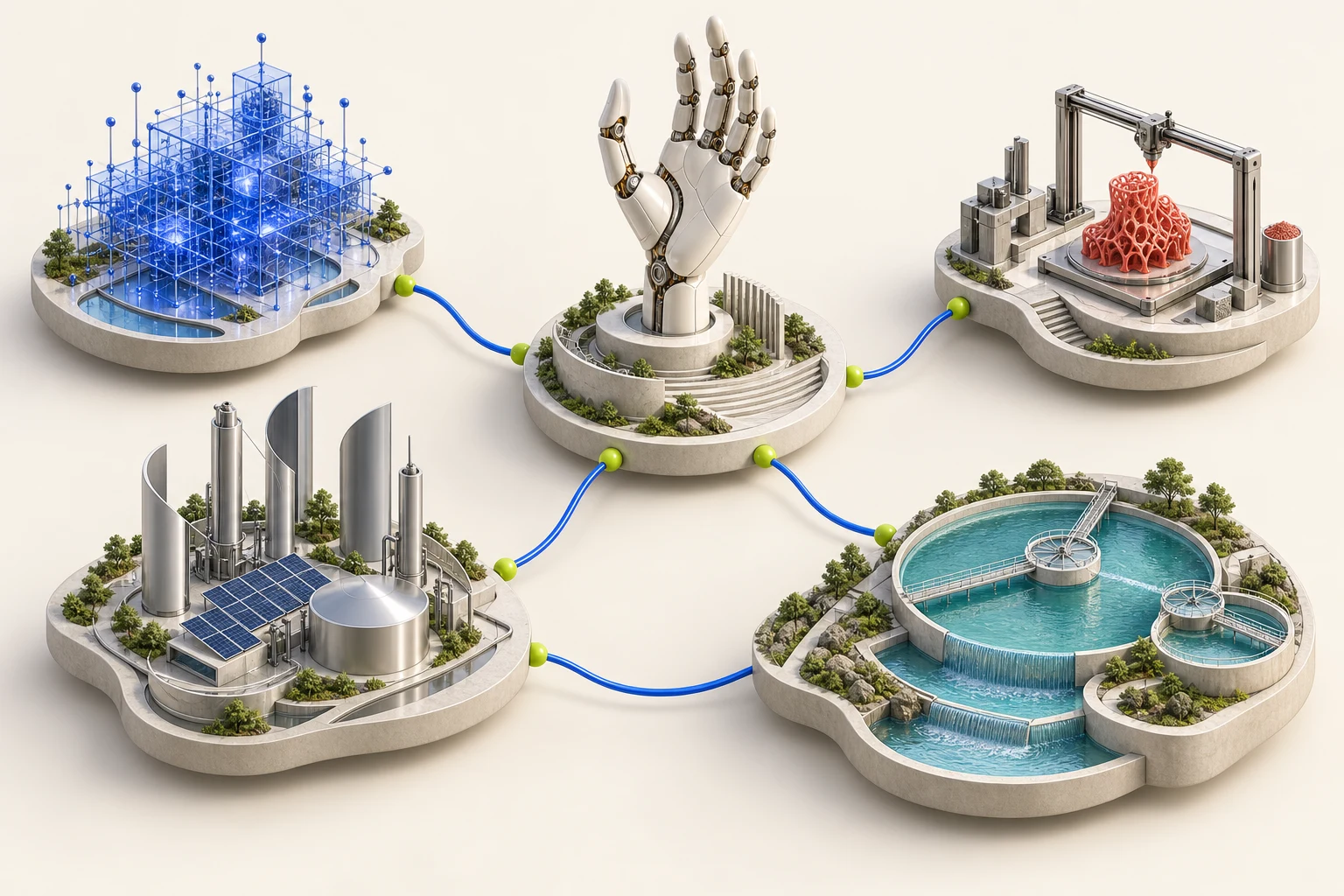
Possible combinations, not completed case studies.
Human augmentation + Wearable devices + Artificial intelligence + 3D printing
Desalination & water + Hydrogen production + Internet of Things + Hyperautomation
Robotics + Internet of Things + Advanced connectivity + Computer vision
04 / WORLDWIDE KNOWLEDGE
Our knowledge framework includes 193 UN member states, two observer states and territories with other statuses. This is a horizon for research, not a claim of offices or operating projects everywhere. Local needs, language, climate and infrastructure shape each solution.
Country → region → municipality → place → real need
05 / LIVING KNOWLEDGE
The project archive includes the original 17 technological centres and later project-preparation methods. A broader 12 ×12 ×17 matrix describes 2,448 possible combinations, not active departments. Historical references to San Marino / Open Planet and other organisations document the evolution of the idea; they do not establish current partnerships.
The descriptions present a developing network concept. Teams, projects and results are published as they are verified. Source edition:9 September 2026.
06 / START A CONNECTION
Tell us what matters, where it matters and what you want to make possible. Start with a question, a technology or a place.